

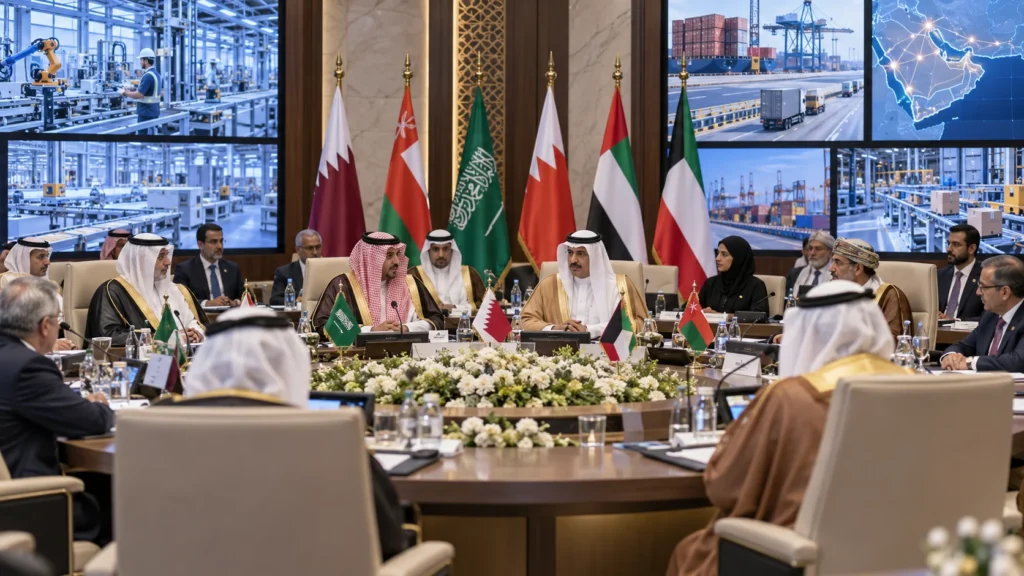
GCC Industrial Cooperation Committee members met in Manama to advance industrial integration, strengthen supply chains and expand cooperation across priority manufacturing sectors, with Saudi Arabia participating through a senior delegation.
The 57th meeting was held in Bahrain and brought together GCC industry ministers and senior officials. Saudi Arabia’s delegation was headed by Prince Sultan bin Khalid bin Faisal, CEO of the Saudi Industrial Development Fund, on behalf of Minister of Energy and Minister of Industry and Mineral Resources Prince Abdulaziz bin Salman.
The meeting focused on industrial coordination, cross-border supply chains and new investment opportunities, while also endorsing GCC participation in the eighth China-Arab States Expo scheduled for August 2027.
GCC Industrial Cooperation Committee Focuses on Integration
The GCC Industrial Cooperation Committee meeting placed industrial integration at the center of discussions.
Officials examined measures aimed at improving coordination among Gulf economies and increasing the interconnectedness of regional supply chains. The broader objective is to build a more integrated Gulf industrial base capable of responding to changing global economic and technological conditions.
GCC Secretary-General Jasem Mohamed Albudaiwi said the industrial sector has become an important pillar of economic development and Gulf integration because of its role in diversifying production, increasing value added and improving competitiveness.
1. Supply Chain Resilience Becomes a Priority
One of the main themes discussed at the GCC Industrial Cooperation Committee was the resilience of Gulf supply chains.
Regional officials highlighted the importance of stronger coordination as global supply networks face pressure from geopolitical tensions, trade disruption and rapid technological change.
The GCC Secretariat said the next phase requires closer industrial coordination and greater resilience across production and logistics networks to ensure Gulf economies can respond more effectively to external shocks.
This focus is particularly important for industries dependent on imported components, raw materials and international shipping routes.
2. Five Joint Gulf Investment Opportunities Prepared
The meeting also advanced five joint industrial investment opportunities in priority sectors.
According to the GCC Secretariat, these opportunities have already entered the promotion stage, with workshops conducted in Saudi Arabia and Oman in coordination with the Federation of GCC Chambers. Officials said the initiatives had received positive engagement from investors.
The projects are part of a broader effort to encourage cross-border industrial investment rather than limiting manufacturing expansion to individual national markets.
For the GCC Industrial Cooperation Committee, attracting regional private capital is an important part of creating a more competitive Gulf manufacturing ecosystem.
3. Gulf Centre for the Fourth Industrial Revolution Launched
Another major development was the launch of the Gulf Centre for the Fourth Industrial Revolution and its digital platform.
The initiative is intended to support the transition toward advanced manufacturing technologies and accelerate digital transformation across factories in GCC states.
Fourth Industrial Revolution technologies typically include artificial intelligence, automation, robotics, advanced analytics and connected manufacturing systems.
The launch reflects the GCC’s attempt to align traditional industrial development with emerging technologies that could improve efficiency, productivity and competitiveness.
4. China-Arab States Expo Participation Endorsed
The GCC Industrial Cooperation Committee also endorsed the participation of the GCC General Secretariat in the eighth China-Arab States Expo, which is scheduled to take place in August 2027.
The expo is expected to provide GCC states with another platform to promote industrial investment and trade cooperation with China.
China remains one of the Gulf region’s most important commercial partners, making industrial and investment engagement with Chinese companies a significant part of the GCC’s broader economic strategy.
Participation in the expo could also help Gulf manufacturers expand market access and identify opportunities in advanced industry, technology and logistics.
5. Gulf Industrial Policies Move Toward Greater Coordination
The meeting also highlighted how GCC industrial policy has become more coordinated in recent years.
According to the GCC Secretariat, joint industrial work has progressed through the alignment of policies and strategies, improvements to regulatory frameworks and efforts to encourage cross-border investment.
That coordination is intended to create a Gulf industrial base that is more integrated and better positioned to compete internationally.
The GCC Industrial Cooperation Committee plays a central role in that process by bringing together industry ministers and senior officials to coordinate priorities across the six member states.
Saudi Arabia Plays a Key Role in Gulf Industrial Development
Saudi Arabia’s participation reflects the Kingdom’s growing emphasis on manufacturing, industrial financing and supply-chain development.
The Saudi Industrial Development Fund, whose CEO headed the Kingdom’s delegation, plays an important role in financing industrial projects and supporting the expansion of domestic manufacturing.
Saudi Arabia has also been increasing investment in advanced industry, mining, logistics and local production as part of its broader economic diversification strategy.
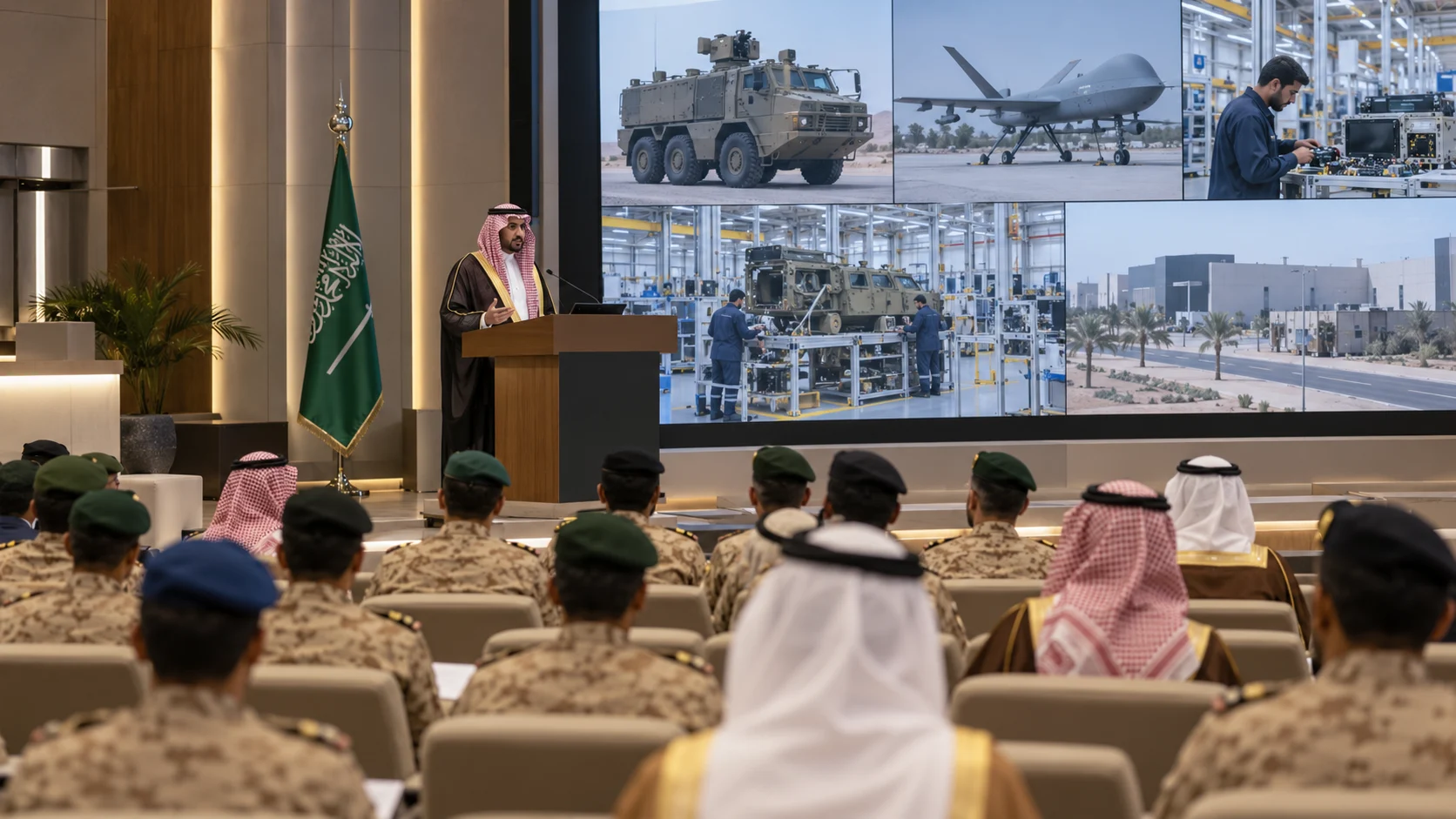
The Arabian Buzz has previously covered Saudi Arabia’s push to deepen industrial and defense-sector localization through major agreements announced at the World Defense Show 2026.
Industrial Integration Supports Gulf Competitiveness
The 57th GCC Industrial Cooperation Committee meeting comes as Gulf states continue trying to reduce dependence on hydrocarbons and increase the contribution of manufacturing and other non-oil sectors.
Greater industrial integration could allow GCC economies to share infrastructure, reduce duplication and create larger regional supply networks.
It could also help manufacturers access a broader Gulf market rather than treating each country as a separate industrial ecosystem.
Officials have also emphasized the importance of smart factories, advanced technologies, industrial financing and workforce development as key parts of the region’s future industrial strategy.
Manama Meeting Sets Stage for Next Phase
The latest meeting in Bahrain suggests that Gulf industrial cooperation is moving beyond broad policy coordination toward more practical initiatives.
The launch of the Fourth Industrial Revolution center, the preparation of five joint investment opportunities and the focus on resilient supply chains all point toward a more coordinated regional manufacturing strategy.
The GCC Industrial Cooperation Committee is expected to remain a key platform for advancing that agenda as member states seek to build stronger and more competitive industrial sectors.
With preparations also underway for the 2027 China-Arab States Expo, the next phase of cooperation is likely to focus increasingly on investment, technology and international market access.
World Defense Show 2026 Accelerates Defense Localization With 28 Strategic Agreements
Source: GCC General Secretariat — Official meeting report
57th GCC Industrial Cooperation Committee meeting
Arab News — Saudi delegation report
Saudi delegation attends GCC industrial meeting