








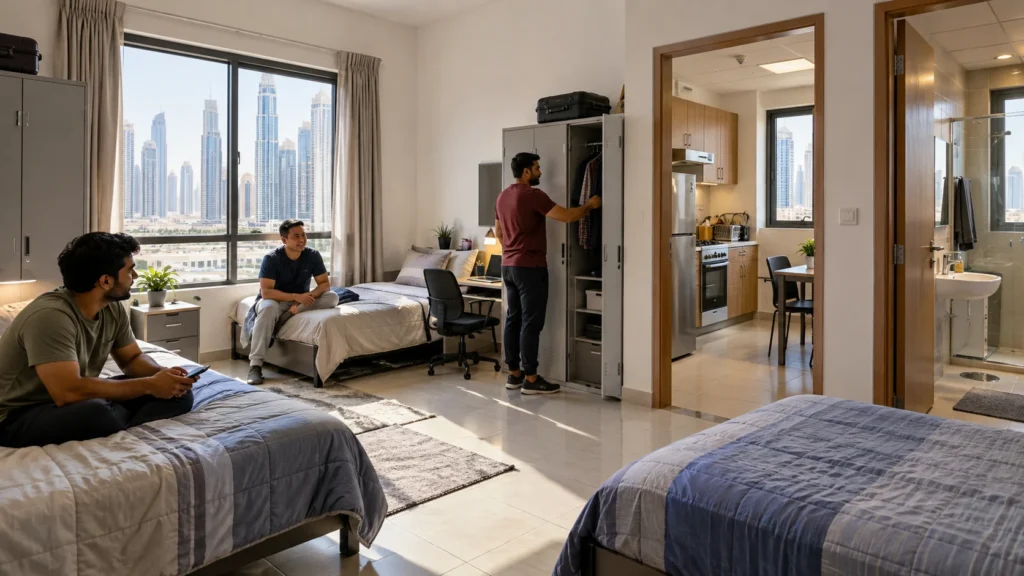
Dubai shared accommodation rules now set clearer minimum standards for bedroom space, bathrooms, kitchens and communal facilities as the emirate moves to regulate shared housing and reduce overcrowding.
According to requirements outlined by Dubai Municipality, residents in shared accommodation must have at least five square metres of bedroom space per person. The rules also establish minimum kitchen-space requirements and limits on how many occupants may use bathrooms, toilets and showers. Khaleej Times
The requirements form part of Dubai’s wider shared-housing framework under Law No. 4 of 2026, which regulates the management and occupancy of shared accommodation and introduces permit, safety and occupancy requirements. Khaleej Times
Dubai Shared Accommodation Rules Set 5 Sq M Per Person
The most prominent requirement is the minimum bedroom allocation.
Under the Dubai shared accommodation rules, each occupant must have at least 5 square metres of space inside a bedroom.
For accommodation classified for individuals, more than one person may share a bedroom, but the number of residents must remain within the approved maximum occupancy and comply with health and technical requirements. Khaleej Times
The rules also permit a living room within a residential unit to be converted for residential use where the relevant conditions are met.
Families are treated differently. More than one family may live in a single residential unit, but each family must have its own separate bedroom. Bedrooms designated for family accommodation must also have an internal bathroom. Khaleej Times
1. Minimum Bedroom Space: 5 Square Metres
The Dubai shared accommodation rules require a minimum bedroom area of five square metres for each resident.
That means occupancy should be calculated according to the actual usable bedroom space rather than simply the number of beds that can physically fit into a room.
For example, a bedroom measuring 20 square metres could theoretically provide the minimum area for four occupants, subject to the building’s approved occupancy limit and other technical requirements.
The rule is designed to reduce overcrowding and ensure residents have a defined minimum amount of personal space.
It is important not to confuse this with separate worker-accommodation standards. Dubai Municipality recently announced updated planning standards for designated workers’ accommodation that include a minimum individual sleeping area of 3.7 square metres, alongside broader gross-floor-area requirements. Dubai Municipality
2. Kitchen Space Must Match Occupancy
Kitchen requirements are another major component of the Dubai shared accommodation rules.
Kitchen space must measure at least one square metre for each occupant of the residential unit.
A unit occupied by six people would therefore require at least six square metres of kitchen space under the standard described by Dubai Municipality.
The kitchen must also comply with relevant safety and public-health requirements under the Dubai Building Code. Khaleej Times
New shared-accommodation buildings designated for individuals may provide communal kitchens on each floor.
In shared accommodation located within apartments, kitchens may remain inside individual units, provided their size and equipment are appropriate for the number of residents.
3. One Complete Bathroom for Every Four People
Bathroom ratios are also specified.
Where a complete bathroom contains a washbasin, toilet and shower, at least one complete bathroom must be provided for every four occupants.
This standard applies to both individual shared accommodation and family housing. Khaleej Times
For example, accommodation housing eight people would require at least two complete bathrooms under this ratio.
These requirements are intended to ensure that sanitary facilities remain proportionate to occupancy and do not become overloaded.
4. Separate Toilets and Showers Have Different Ratios
The Dubai shared accommodation rules also cover properties where toilets and showers are separated rather than combined into complete bathrooms.
In accommodation designated for individuals:
- at least one toilet must be provided for every four occupants
- at least one shower must be provided for every six occupants
This arrangement is permitted for individual accommodation rather than family housing. Khaleej Times
The distinction is important because landlords and operators cannot simply apply the same ratio across every type of shared property.
5. Dining, Recreation and Laundry Areas Are Required
New shared-accommodation buildings designated for individuals must also provide additional common facilities.
These include multipurpose halls designed to accommodate the number of residents using the building.
The halls may be used for dining and recreation and must be furnished appropriately for their intended purpose under the Dubai Building Code and relevant technical requirements. Khaleej Times
Laundry facilities are also required.
Buildings must provide dedicated areas for washing and drying clothes, including washing basins and suitable drying spaces proportionate to the number of occupants.
Shared Housing Law Also Requires Permits
The technical standards sit within a broader regulatory system.
Dubai’s new shared-housing law prohibits a person or entity from designating a residential unit as shared housing without obtaining the required permit.
Properties must also comply with maximum occupancy limits, building requirements and health, fire, sanitation, security and electrical-safety standards. Khaleej Times
The law also regulates who may lease shared housing and restricts unauthorised subletting.
Dubai has been tightening enforcement around overcrowded and improperly partitioned accommodation in recent years, particularly where alterations pose fire or building-safety risks. Khaleej Times
What Residents and Landlords Should Check
For anyone using shared accommodation, the most important Dubai shared accommodation rules are now relatively straightforward.
Bedrooms should provide at least five square metres per person, kitchens must provide at least one square metre per resident, and complete bathrooms must generally be available at a ratio of one for every four occupants.
Where toilets and showers are separate in individual accommodation, the ratios change to one toilet per four people and one shower per six.
Residents and landlords should also confirm that the property itself is approved for shared accommodation and complies with permit and building requirements.
The new framework is intended to make shared housing more predictable and safer while reducing overcrowding and informal accommodation practices across Dubai.
Source: Dubai Municipality / Khaleej Times
External DoFollow Links
Use these as normal WordPress links and do not enable nofollow:
Dubai Municipality — Dubai Building Code
Dubai Building Code
Khaleej Times — original shared accommodation rules report
Dubai shared accommodation rules report