






US aircraft losses in Iran war operations have reached at least 81 aircraft, helicopters and drones destroyed, lost or damaged since fighting began in late February, according to an updated Congressional Research Service assessment.
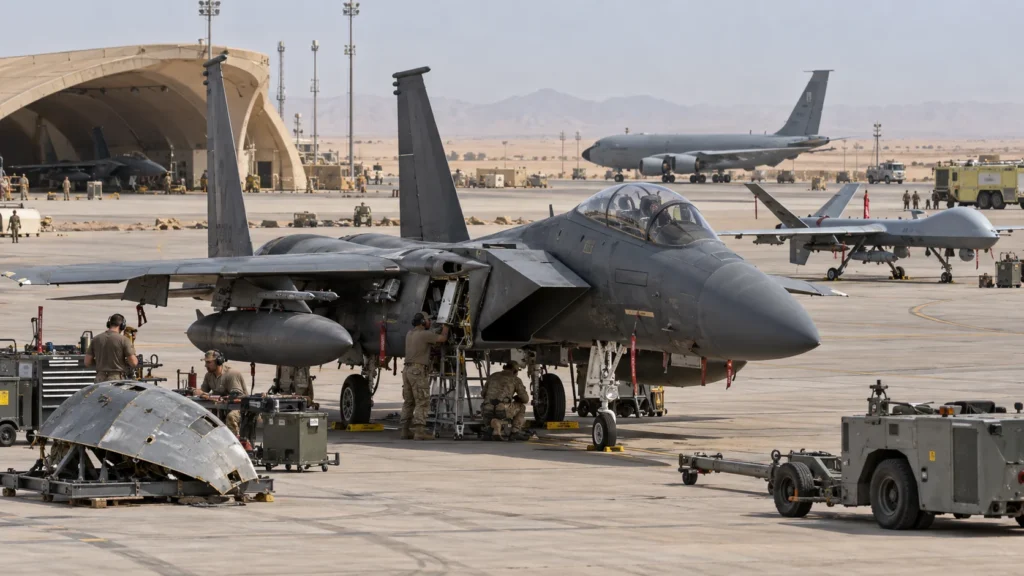
The October 5 tally includes 45 MQ-9 Reaper drones, 12 F-15E Strike Eagle fighters and seven KC-135 aerial refuelling aircraft, along with several other crewed and unmanned platforms.
However, the figure does not mean that all 81 aircraft were permanently destroyed. The tally also includes aircraft that sustained damage and were later returned to operational service, according to reporting on the CRS assessment.
US Aircraft Losses in Iran War Reach 81
The latest US aircraft losses in Iran war tally represents one of the broadest public assessments so far of the impact of the conflict on American air power.
Gulf News reported that the Congressional Research Service count includes 45 MQ-9 Reapers, 12 F-15Es, seven KC-135 tankers, two A-10 Thunderbolt II aircraft, two MC-130J Commando II aircraft, an F-35A Lightning II, an E-3 Sentry, an HH-60W Jolly Green II helicopter and an MQ-4C Triton surveillance drone.
The list also includes four AH-6 Little Bird helicopters, three MQ-1-series drones, an AH-64 Apache and an MH-60 Sea Hawk.
CRS cautioned that the number remains subject to revision because combat operations continue and some incidents remain difficult to assess publicly.
1. MQ-9 Reaper Drones Account for Largest Share
The largest single category in the US aircraft losses in Iran war tally is the MQ-9 Reaper.
CRS lists 45 Reaper drones as lost or damaged, accounting for more than half of the total aircraft in the updated assessment.
That number is significantly higher than earlier public estimates.
The Reaper is widely used by the US military for intelligence, surveillance, reconnaissance and strike missions, making losses in this category particularly relevant to future operational planning.
The report raises questions for Congress over how quickly those aircraft can be replaced and whether the existing fleet can continue supporting operations in multiple regions.
2. Twelve F-15Es Listed as Destroyed or Damaged
The tally includes 12 F-15E Strike Eagles, but this number also needs context.
Four were destroyed earlier in the conflict, while another eight reportedly suffered lighter damage during an Iranian ballistic missile attack on Muwaffaq Salti Air Base in Jordan in September.
Those eight aircraft were subsequently returned to service, according to reports cited in the assessment.
Three of the four destroyed F-15Es were lost during an apparent friendly-fire incident over Kuwait in March.
US Central Command said Kuwaiti air defenses mistakenly shot down three F-15Es during active combat involving Iranian aircraft, ballistic missiles and drones. All six crew members ejected safely and were recovered.
A fourth F-15E was reportedly lost during combat operations over Iran, with its crew also rescued.
3. Friendly Fire Adds to Combat Losses
The US aircraft losses in Iran war have therefore come from multiple causes, including hostile fire, missile attacks and friendly fire.
The March Kuwait incident is one of the clearest examples.
CENTCOM formally acknowledged that three F-15E Strike Eagles supporting Operation Epic Fury went down after being mistakenly engaged by Kuwaiti air defenses.
Friendly-fire losses can be particularly significant because they highlight the challenges of coordinating complex air-defense networks during intense multi-domain combat.
When multiple friendly and hostile aircraft, drones and missiles are operating simultaneously, identification and deconfliction become critical.
4. Financial Cost Continues to Rise
The aircraft tally is only one part of the wider financial cost of the war.
According to reporting cited by Gulf News, the Congressional Budget Office estimated that replacing equipment lost through August 1 could cost between $1.9 billion and $3.3 billion, depending on Pentagon replacement decisions.
A separate US Central Command estimate provided to lawmakers reportedly put the overall cost of the war at $43.6 billion as of September 3.
That figure included approximately $28.1 billion for expended munitions and around $4.3 billion for equipment losses, in addition to broader operational costs.
The estimate did not include all damage to US military bases across the Middle East.
5. Losses Raise Questions About US Air Power
The updated US aircraft losses in Iran war tally also raises longer-term strategic questions.
Congress is expected to examine whether the military has sufficient aircraft to maintain operations elsewhere while replacing equipment lost or damaged in the Middle East.
Some aircraft on the list come from relatively small or ageing fleets.
The E-3 Sentry, for example, is a long-serving airborne command-and-control platform, while tanker aircraft such as the KC-135 remain important for sustaining long-range air operations.
The presence of an F-35A in the tally is also notable because the aircraft is among the most advanced fighters in the US inventory.
Not All 81 Aircraft Were Permanently Lost
This distinction is essential when interpreting the headline figure.
The US aircraft losses in Iran war count combines aircraft that were destroyed, crashed or permanently lost with others that were damaged.
Eight F-15Es damaged in Jordan, for example, were reportedly repaired and returned to service.
That means the 81-aircraft figure should not be interpreted as 81 aircraft permanently removed from the US inventory.
CRS itself notes that the tally may change as additional information becomes available and the status of damaged aircraft becomes clearer.
Congressional Review Likely to Continue
The updated tally is likely to feed into congressional debate over military readiness, replacement funding and the strength of the US defense-industrial base.
Lawmakers may also consider whether the aircraft losses reveal vulnerabilities in basing, air-defense coordination and operational tactics.
For now, the latest US aircraft losses in Iran war assessment provides a clearer picture of the scale of damage to American aviation assets while also showing why headline numbers require careful interpretation.
At least 81 aircraft are listed as lost or damaged, but the operational impact varies significantly depending on whether each platform was destroyed, temporarily damaged or returned to service.
Source: Congressional Research Service reporting / Gulf News / US Central Command
Gulf News — original report
US lost or damaged 81 aircraft in Iran war
US Central Command — official friendly-fire statement
CENTCOM statement on three F-15Es lost over Kuwait