
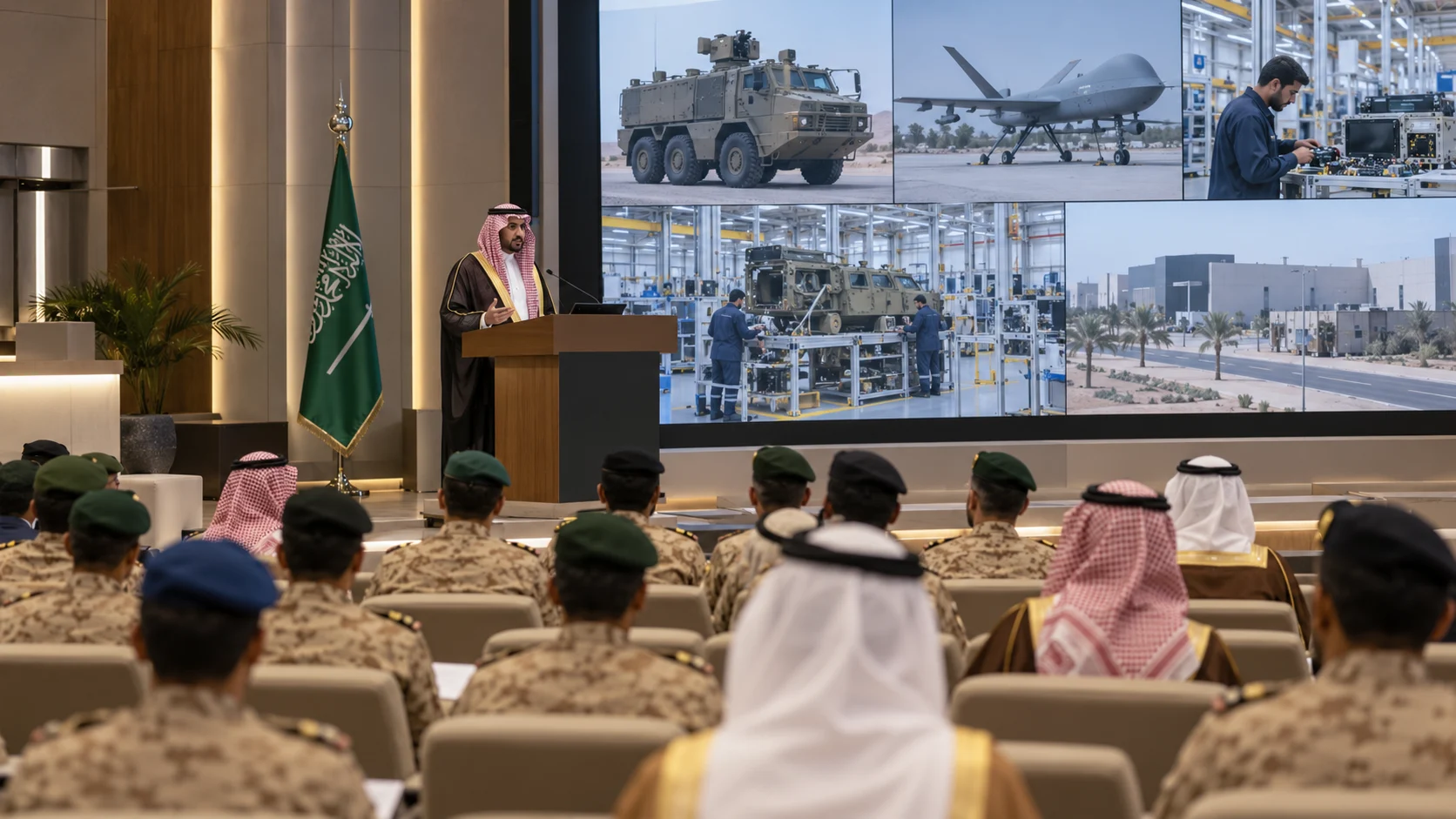
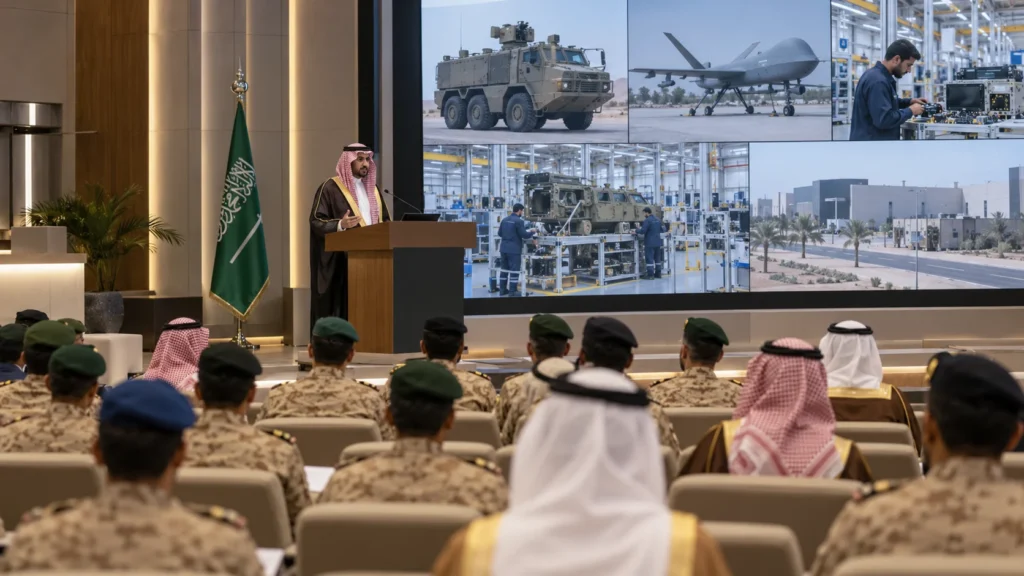
Saudi military localization drive was the focus of a recent lecture delivered by Minister of State and acting governor of the General Authority for Military Industries Bandar Al-Khorayef at the King Abdullah bin Abdulaziz Command and Staff College.
Al-Khorayef reviewed the development of Saudi Arabia’s military industries sector under Vision 2030, including efforts to localize defense manufacturing and technology while building sustainable national capabilities, according to the Saudi Press Agency and Arab News.
The lecture was attended by Maj. Gen. Abdullah bin Saleh Al-Anazi, commander of the college, along with officials from the Ministry of National Guard.
Saudi Military Localization Drive Supports Strategic Autonomy
The Saudi military localization drive forms part of a wider Vision 2030 objective to build a more self-sufficient domestic defense-industrial base.
GAMI says its strategic goal is to localize more than 50 percent of government spending on military equipment and services by 2030. The authority links that target to stronger military readiness, strategic autonomy, more efficient spending and sustainable domestic defense industries.
Al-Khorayef’s lecture focused on how those goals translate into industrial development, local technology capabilities and long-term national capacity.
1. More Than 50% of Military Spending Targeted for Localization
The central benchmark behind the Saudi military localization drive is the 2030 target.
GAMI says military-industry localization reached 24.89 percent by the end of 2024, up significantly from earlier years, while the long-term objective remains above 50 percent.
The strategy is not limited to assembling imported systems inside the Kingdom. It also emphasizes local manufacturing, maintenance, research, technology development and supplier capabilities.
That distinction is important because deeper localization requires domestic companies to participate in more stages of the defense value chain.
2. Technology Transfer Is a Core Priority
Another major part of the Saudi military localization drive is the transfer and development of advanced technologies.
GAMI’s policy framework identifies research and technology as one of the main pillars of the sector alongside military acquisition and industrial development.
The goal is to build national capabilities that can support the operation, maintenance and future development of military systems inside Saudi Arabia.
This includes areas such as electronics, unmanned systems, communications, advanced manufacturing and specialized components.
3. Sustainable Domestic Defense Capabilities
Al-Khorayef also emphasized the importance of building sustainable national defense capabilities rather than relying solely on foreign procurement.
GAMI describes sustainability of local military industries as one of its strategic priorities, alongside readiness and strategic autonomy.
A sustainable defense-industrial base requires local suppliers, skilled engineers, technicians, testing facilities, maintenance capabilities and long-term demand.
That approach can help retain more defense spending inside the domestic economy while reducing reliance on overseas support for certain systems and services.
4. Supply Chains Are Being Built Inside the Kingdom
The Saudi military localization drive also depends heavily on developing local supply chains.
GAMI says its military-industries supply-chain program includes 74 investment opportunities valued at SAR175 billion, covering areas where domestic production or services can be expanded.
The authority has also created mechanisms to connect investors with local suppliers and identify capability gaps across the defense sector.
Such supply-chain development is essential because major defense platforms rely on thousands of components, maintenance services and specialized technologies.
Localization therefore requires more than a handful of large manufacturers; it also depends on a broader ecosystem of small and medium-sized suppliers.
5. Human Capital Remains Essential
Building domestic industrial capability also requires trained Saudi talent.
GAMI’s Military Industry Human Capital strategy focuses on national competencies, research, technology and the creation of skilled jobs linked to defense manufacturing.
The authority has previously estimated that deeper defense localization could support tens of thousands of direct and indirect jobs while contributing to non-oil GDP.
The lecture at the National Guard college therefore fits into a broader effort to connect military leadership, industrial policy and workforce development.
Saudi Arabia Expands Defense Investment Opportunities
The Saudi military localization drive is also intended to attract both domestic and international investment.
GAMI provides licensing and investment frameworks for companies seeking to manufacture defense products or participate in local supply chains.
Its Industrial Participation Program is designed to encourage foreign contractors supplying Saudi defense entities to contribute to domestic industrial capability through investment, technology transfer and partnerships with local companies.
The approach is intended to turn defense procurement into a mechanism for building longer-term economic value inside the Kingdom.
Localization Has Broader Economic Goals
The defense-localization strategy is also connected to Saudi Arabia’s wider economic diversification agenda.
GAMI says developing the military-industries sector can support non-oil economic growth, create high-skilled employment and strengthen local manufacturing.
That makes military localization both a defense policy and an industrial policy.
The Arabian Buzz has previously covered the Kingdom’s defense-industrial expansion through the World Defense Show 2026, where strategic agreements highlighted growing emphasis on localization, technology partnerships and domestic capability.
National Guard College Lecture Highlights Long-Term Strategy
The lecture by Al-Khorayef reflects the strategic importance Saudi authorities place on connecting defense leadership with industrial development.
By presenting the evolution of the military-industries sector to officers and officials at the King Abdullah bin Abdulaziz Command and Staff College, the government is reinforcing the link between military readiness and domestic industrial capability.
The Saudi military localization drive is therefore not only about increasing local procurement percentages.
It is also about building a defense ecosystem capable of supporting national security through manufacturing, technology, research, supply chains and Saudi expertise.
As Vision 2030 approaches its final years, progress toward the more-than-50-percent localization target will remain one of the key indicators of how far the Kingdom has advanced in building a sustainable domestic military-industrial base.
The Arabian Buzz has also covered the Kingdom’s defense-industrial expansion through the World Defense Show 2026 strategic agreements, which highlighted localization and technology partnerships.
Source: Arab News — original report
Saudi minister outlines military localization drive
GAMI — official localization strategy
GAMI military-industry localization progress