





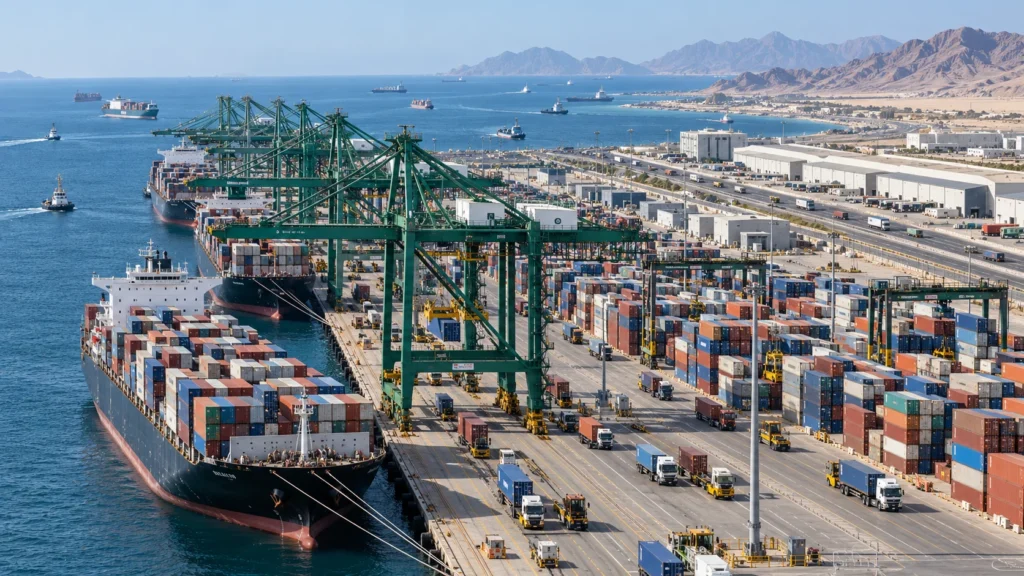
Saudi logistics resilience remains strong despite nine months of regional conflict and mounting pressure around the Bab Al-Mandab Strait, with Red Sea ports handling record cargo volumes, according to a senior shipping executive.
Akshay Anand, group CEO of shipping, logistics and freight company ABSA Al Barrak Group, told Arab News at the Saudi Maritime and Logistics Congress in Jeddah that cargo had continued flowing through the Kingdom despite repeated disruptions affecting key regional trade routes.
He described Saudi Arabia’s logistics network as “extremely resilient,” pointing to the Kingdom’s access to both the Red Sea and Arabian Gulf, its inland transport capacity and the development of alternative trade routes.
Saudi Logistics Resilience Holds Despite Bab Al-Mandab Pressure
The latest comments on Saudi logistics resilience come as maritime operators confront continuing uncertainty around Bab Al-Mandab, the narrow southern entrance to the Red Sea.
Anand said the location of Saudi Arabia gives logistics companies options that many countries do not have. When pressure increased around the Strait of Hormuz, cargo could move through western ports on the Red Sea.
Now, as security concerns shift toward Bab Al-Mandab, operators are again adapting routes and supply chains rather than stopping trade altogether.
1. Red Sea Ports Are Handling Record Cargo Volumes
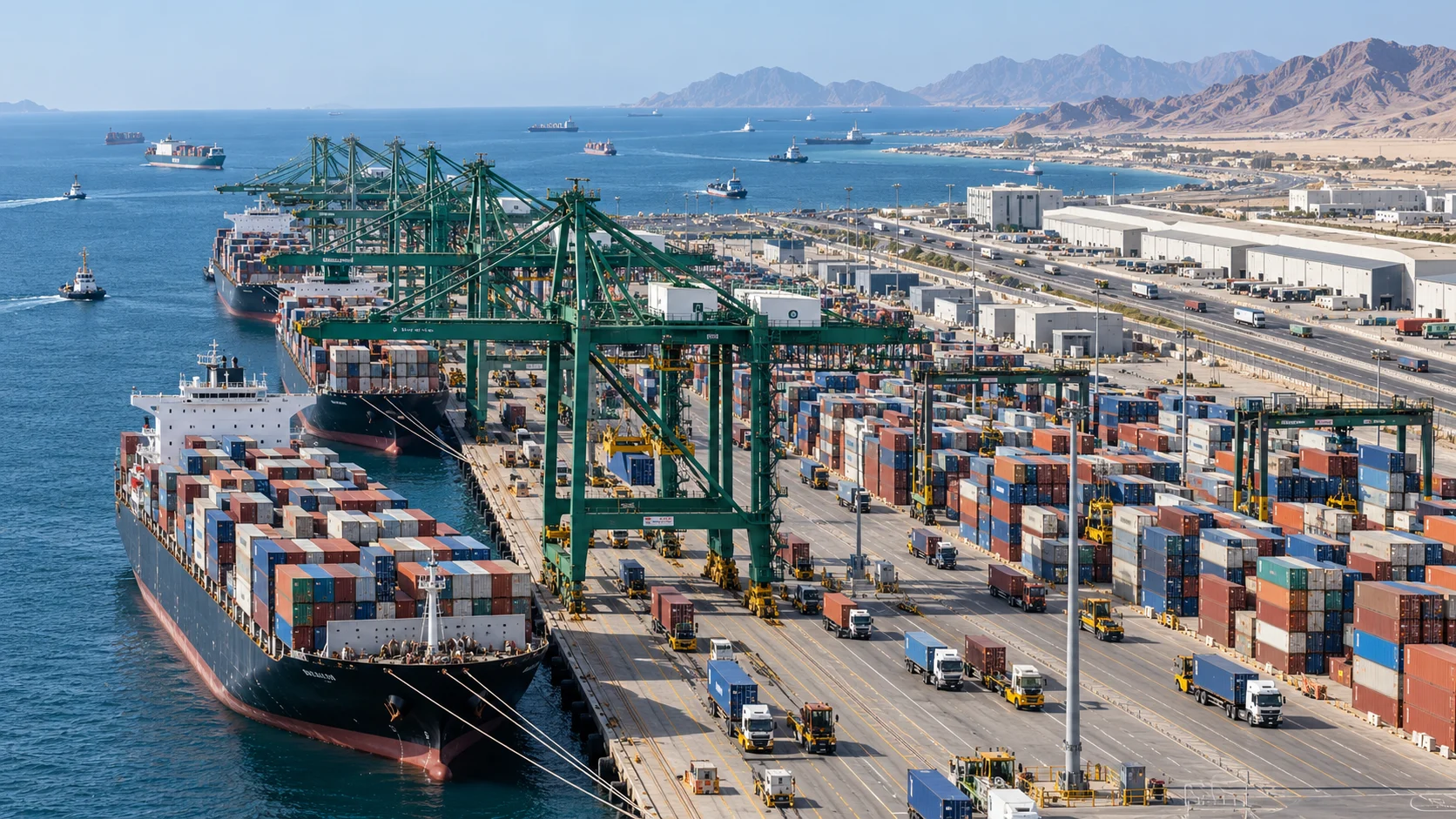
One of the clearest indicators of Saudi logistics resilience is cargo throughput at Red Sea ports.
Anand said the Kingdom was currently seeing record cargo volumes through those ports despite continuing regional conflict and maritime-security risks.
The figures suggest that shipping companies and logistics operators have been able to reroute, reorganize and absorb pressure without a full interruption to trade.
That does not mean the system is operating without added cost or risk. Insurance, security, scheduling and route planning can all become more complicated during periods of instability.
However, cargo continuing to move at high volumes indicates that the Kingdom’s logistics system has retained substantial operating capacity.
2. Saudi Arabia Benefits From Two Maritime Fronts
Saudi Arabia’s geography is another important factor behind Saudi logistics resilience.
The Kingdom has major ports on both the Red Sea and the Arabian Gulf, providing alternatives when one maritime route comes under pressure.
Anand said that when the Strait of Hormuz faced disruption, the Red Sea remained available. When risks later increased in the Red Sea, operators continued looking for alternatives through land corridors and other regional connections.
This flexibility does not eliminate dependence on strategic chokepoints, but it provides more options for maintaining trade.
Other shipping executives at the Jeddah congress also argued that Saudi Arabia needs to continue developing routes that reduce exposure to both the Strait of Hormuz and Bab Al-Mandab over the longer term.
3. Inland Transport Helps Absorb Disruption
The domestic transport network is another major component of Saudi logistics resilience.
Anand described Saudi inland logistics capacity as robust and said it had helped absorb the strain caused by changing maritime conditions.
Road freight, warehousing, distribution centers and links between ports and major cities can give logistics operators more flexibility when cargo has to arrive through different gateways.
At the same congress, Anand pointed to goods now reaching Saudi Arabia from Turkiye through Syria as an example of how trade routes can adapt when conventional corridors become more difficult.
He stressed that road transport cannot replace maritime shipping entirely, but alternative land routes can form part of a wider contingency network.
4. Shipping Companies Are Building Backup Plans
The wider industry is increasingly treating disruption as a permanent planning factor rather than a temporary exception.
Karim Omran of Red Sea Gateway Terminal told Arab News that shipping lines were developing contingency plans around Bab Al-Mandab and adapting their networks to possible interruptions. He said current container volumes were close to levels seen in the fourth quarter of the previous year.
Major shipping companies are therefore planning around multiple scenarios, including the possibility that access to a maritime corridor could suddenly become more difficult.
That operational flexibility supports Saudi logistics resilience by reducing reliance on a single fixed route or schedule.
5. Vision 2030 Makes Logistics a Strategic Sector
Saudi Arabia’s logistics performance also reflects years of investment linked to Vision 2030.
Transport and logistics are central to the Kingdom’s diversification strategy, which aims to strengthen Saudi Arabia’s position as a global hub connecting Asia, Africa and Europe.
That involves ports, roads, railways, warehouses, digital logistics platforms and integrated supply chains.
The goal is not only to increase cargo capacity but also to make the overall system more adaptable during disruptions.
Saudi Arabia’s location between major trade corridors gives it a natural advantage, but infrastructure and coordination determine how effectively that advantage can be used during a crisis.
Bab Al-Mandab Remains a Serious Pressure Point
Despite positive cargo figures, Bab Al-Mandab remains a significant vulnerability.
The strait connects the Red Sea to the Gulf of Aden and forms part of the route used by vessels traveling between Asia and Europe through the Suez Canal.
Any disruption can force vessels to take longer routes, increase fuel consumption and raise insurance and freight costs.
Industry executives at the Saudi Maritime and Logistics Congress emphasized that perceived and actual risk around the strait remain important factors in shipping decisions.
Some major carriers have continued or resumed operations through the route while maintaining contingency plans.
Security Threats Continue Alongside Trade Activity
The comments on Saudi logistics resilience came as security threats continued elsewhere in the Kingdom.
The coalition said Saudi air defenses intercepted five explosive-laden drones launched toward Madinah and the Eastern Province. Coalition spokesman Maj. Gen. Turki Al-Maliki said there were no casualties or damage to vital installations in those incidents.
Those security developments form part of the wider environment facing logistics operators, but they are separate from the cargo-volume figures cited by Anand.
The key industry message is that companies are attempting to keep commercial activity functioning even while managing elevated security risks.
Costs of Disruption Remain a Challenge
Resilience does not mean disruption is free.
Shipping companies can face higher insurance premiums, additional security costs, longer routes and delays when maritime risk increases.
Executives at the Jeddah congress argued that these costs should be shared more fairly across the supply chain rather than falling disproportionately on weaker participants.
Anand also called for contractual and arbitration frameworks to evolve toward a more collaborative approach.
That issue could become increasingly important if geopolitical uncertainty becomes a long-term feature of Gulf and Red Sea trade.
Saudi Logistics Strategy Faces Its Biggest Stress Test
The current environment is providing a real-world test of Saudi logistics resilience.
Record cargo flows through Red Sea ports and the use of alternative land and maritime routes suggest the system has been able to adapt so far.
However, the continuing risks around Bab Al-Mandab and other chokepoints mean operators cannot rely on existing routes remaining continuously available.
The Arabian Buzz has previously reported on the wider regional risks to maritime trade in its coverage of the Strait of Hormuz tanker attack and on Gulf efforts to build more resilient supply chains through the GCC Industrial Cooperation Committee.
For Saudi Arabia, the challenge is increasingly clear: resilience will depend not only on expanding ports and cargo capacity, but also on maintaining enough route diversity, inland connectivity and contingency planning to keep trade moving during prolonged regional instability.
Source: Arab News — original report
Saudi logistics resilient despite Bab Al-Mandab pressure
Arab News — alternative Saudi trade routes
Saudi Arabia needs trade route independent of maritime chokepoints